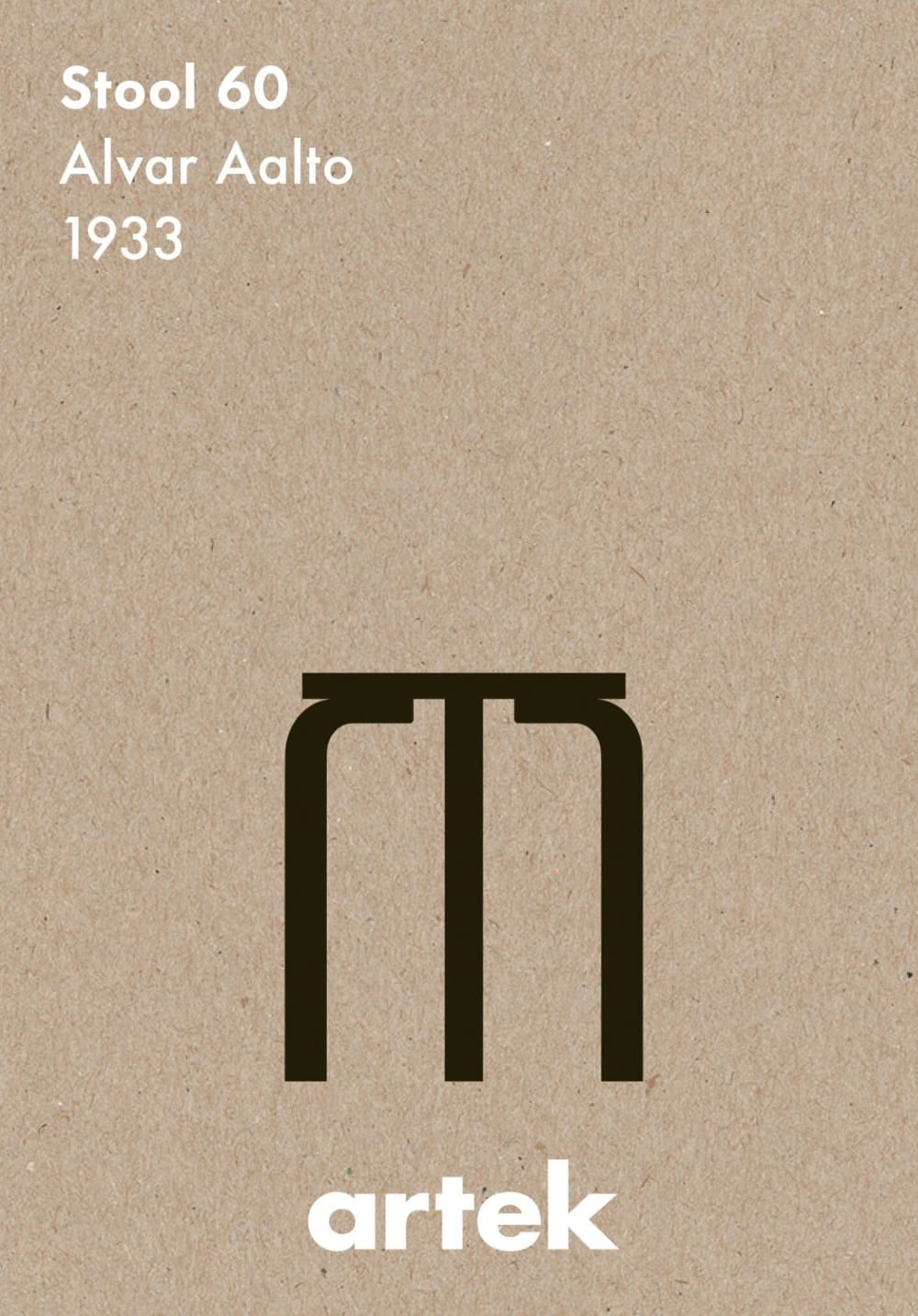
ALVAR AALTO, 1933

Object
Stool 60 by Alvar Aalto is a classic wooden stool in furniture design history. Produced by Artek, it is a three-legged stool with a simple and essential look, made from natural birch wood. It is stackable, practical, and elegant.
Stool 60 was designed in 1933 by Alvar Aalto as furniture for his Viipuri Library, a building considered one of the masterpieces of the Finnish architect. A distinctive feature of Aalto was his meticulous attention to detail in his architectural projects, extending even to the interiors.
For the famous Viipuri Library, Aalto also created furniture that would later be produced by Artek, the design company he founded with his wife, Aino. Among these, Stool 60 has been the most successful, exerting a significant influence on the world of design.
The stool is an essential piece, manufactured using innovative production techniques for its time, particularly to create the L-shaped curvature of the three legs. It maximizes the use of the natural resources Finland is rich in: birch wood.
Its commercial success began right away in 1933 when it was presented by Artek in London at Fortnum & Mason. That same year, 2,000 units were sold (the reception of Artek’s furniture in London was exceptional), and from that moment, the fame of Aalto’s beautiful stool has never faded.
The success of Stool 60 is also linked to matters of style and originality, and undoubtedly to the great talent of Alvar Aalto. In the 1930s, the public began to discover Bauhaus objects and modernist tubular steel furniture (such as Marcel Breuer’s Wassily chair or the LC4 Chaise Longue by Le Corbusier and Perriand). Despite the great appeal of new materials and production techniques, the Finnish architect decided to use the traditional materials of his homeland, creating a very specific style and remaining faithful to it in all subsequent projects.
The Production of Stool 60: Artek
One of the reasons why Aalto’s stool has enjoyed phenomenal success (its production has never stopped in the last 90 years) is the simplicity of the design combined with the ingenuity of its fabrication.
Aalto himself devised a technique that allowed the three legs to be bent into the famous L-shape, ensuring strength and stability even under weight.
The technique involves inserting several layers of birch veneer into comb-like longitudinal cuts made in the solid wood legs. This way, the curved legs can provide the necessary stability.
The manufacturing methods of the stool have continued to evolve over the years while remaining faithful to Alvar Aalto’s original design. Today, production involves 65 steps, divided between manual and machine work.
2023: New Versions for the 90th Anniversary of Stool 60
The year 2023 marks the 90th anniversary of the famous stool. To celebrate the occasion, Artek (which was acquired by Vitra in 2013) has created three special series of the stool.
The first, Stool 60 Kontrasti, highlights the thermally treated birch veneer layers used to reinforce the strength and stability of the wooden legs. These layers are in a darker tone, creating a contrast with the natural birch wood.
The third variant, Stool 60 Villi, in collaboration with the studio Forma Fantasma, focuses on sustainability and the impact of climate change on Finnish birch. Knots, grain patterns, and imperfections caused by insects are intentionally kept visible, creating a narrative that connects Stool 60 to the changing environmental conditions.
Cultural impact
The cultural impact of Alvar Aalto’s Stool 60 is significant and difficult to quantify. The stool, along with other seating designs by Aalto for Artek, has been a fundamental object in the education of designers worldwide, generation after generation.
Today, the stool is part of the most important museum collections in the world, including the MoMA in New York, which added it to its permanent collection in 1958, as well as the Vitra Design Museum, the Alvar Aalto Museum, and many others.
Alvar Aalto

Alvar Aalto (1898-1976), Finnish designer and architect, revolutionized design with his bent wood technique. He is famous for the Paimio chair, designed in 1932, and the Savoy vase of 1936, which reflect an organic design inspired by nature. As the cofounder of Artek, Aalto integrated functionality and aesthetics, profoundly influencing modern and Scandinavian design.
Continua a Leggere
Details
Artek
The original version of the famous Stool 60 by Alvar Aalto is available online at Mohd.it >
Natural birch wood.