MARCEL BREUER, 1925-26

Object
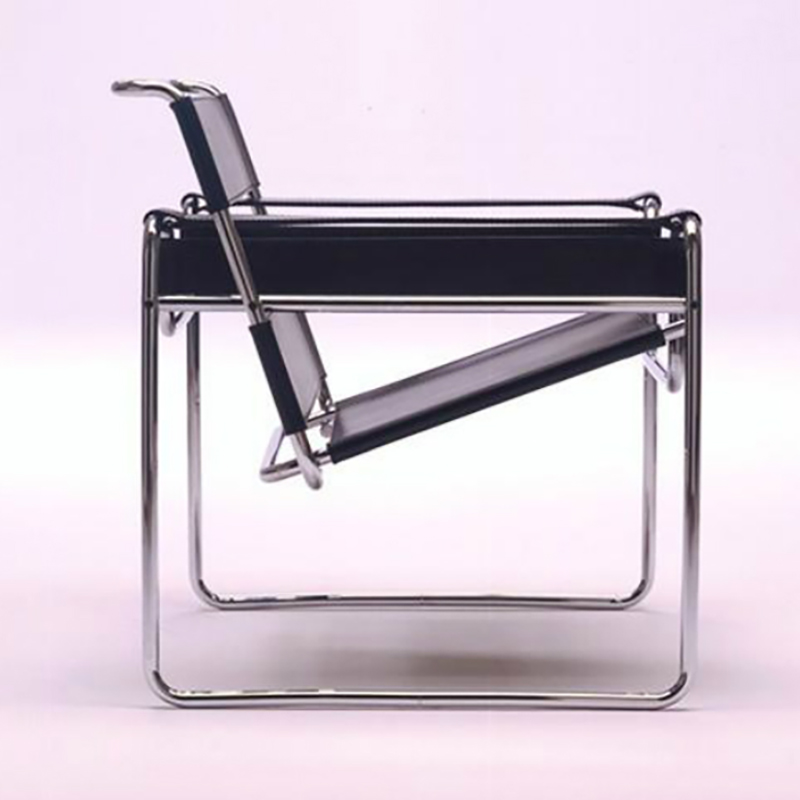
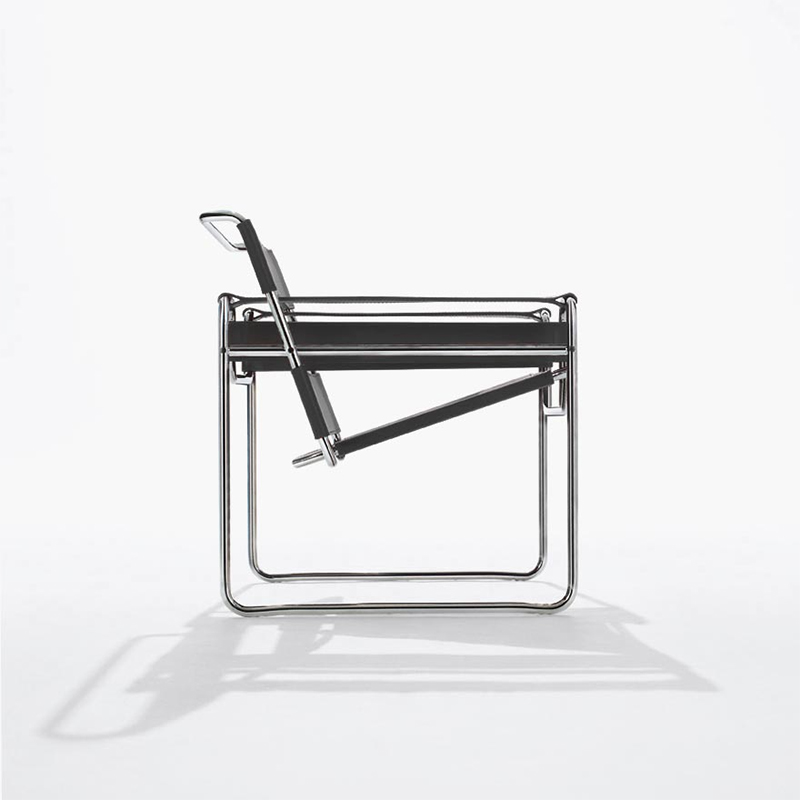
The Wassily Chair is the most famous design by Marcel Breuer, an architect and designer who was first a student and then a master at the Bauhaus, where he led the carpentry workshop. Legend has it that the inspiration for the iconic chair came to Breuer while observing a bicycle frame, giving him the idea to bend a metal tube to form the structure of a chair.
Breuer’s idea was to reduce a classic club chair to its minimum possible components, using a tubular metal frame for the structure and fabric straps for the seat and backrest.
The young architect was further inspired by the joints in plumbing and the techniques of German plumbers to find the perfect method for bending tubular steel.
This led to the creation of the Wassily Chair, as well as a series of tubular metal furniture, including the Cesca Chair and the B2 Tables, which made Breuer one of the most renowned designers and architects of his time.
In perfect Bauhaus style, the chair incorporates many principles of the school. The functionality and needs of humans are at the center of the design, which uses industrial materials and rejects the highly decorative aesthetic that had dominated furniture design until then.

Production: From Bauhaus to Knoll International
The Wassily Chair was designed by Breuer in 1925-26, but unlike some of his other tubular metal furniture designs, it did not enter production at Standard-Möbel in Berlin (Breuer’s own furniture company).
Instead, it was included in the Thonet catalog from the late 1920s. The first Thonet models, listed as Model B3, offered both foldable and non-foldable versions, primarily with straps made of Eisangam, a very durable waxed fabric invented in the Bauhaus weaving workshop.
With the advent of World War II, the production of the Wassily Chair halted, along with that of many other pieces of furniture, as happened throughout Europe. This mirrors the story of Eileen Gray‘s lacquered wood workshops, which also closed during the war. With the post-war economic recovery, the legendary Italian design company Gavina resumed the production of the chair, introducing leather straps for the seat and backrest, giving the chair the appearance we know today.
The final chapter in the production of the Wassily Chair came with Knoll International’s acquisition of Gavina in 1968. Since then, the iconic Bauhaus chair, one of the most recognizable symbols of European modernist design, has been part of Knoll’s catalog, where it continues to be successfully produced and marketed to this day.
The Wassily Chair in Museums
The cultural impact of the Wassily Chair has been immense. From an experimental Bauhaus object to a modernist design icon, this chair continues to influence generations of designers. It is undoubtedly a symbolic object, representing the aesthetic movement of an era and an elegant and exclusive design piece for today’s design enthusiasts.
Marcel Breuer’s chair is part of the permanent collections of the world’s best design museums, including MoMA in New York, the Met in New York, Bauhaus Archiv in Berlin, SF MoMA, V&A Museum, and MAD in Paris, to name a few.
MArcel Breuer

Marcel Breuer, a Hungarian-American designer and architect, key figure in the Bauhaus movement. Breuer stood out for his innovative use of tubular steel, a technique that revolutionized the furniture industry. His iconic Cesca and Wassily chairs, made with a tubular steel frame have become a symbol of functionality and minimalism.
Knoll International

Knoll International, founded in 1938 by Hans Knoll, collaborated with figures such as Mies van der Rohe, Eero Saarinen, and Florence Knoll, creating icons like the Barcelona chair and the Womb chair. Its designs revolutionized office and home furnishings, setting new and modern standards.
Discover more
Details
Knoll International
Dimensions of the Wassily Chair:
- Width: 79 cm
- Depth: 69 cm
- Height: 73 cm
Materials of the Wassily Chair:
- Frame: Chrome-plated tubular metal
- Straps: Bovine leather